Showing posts with label Rules of Engagement. Show all posts

Monday, April 7, 2014

Flattering My Fair Lady (Part 2 of a series)

Flattery is Fallible
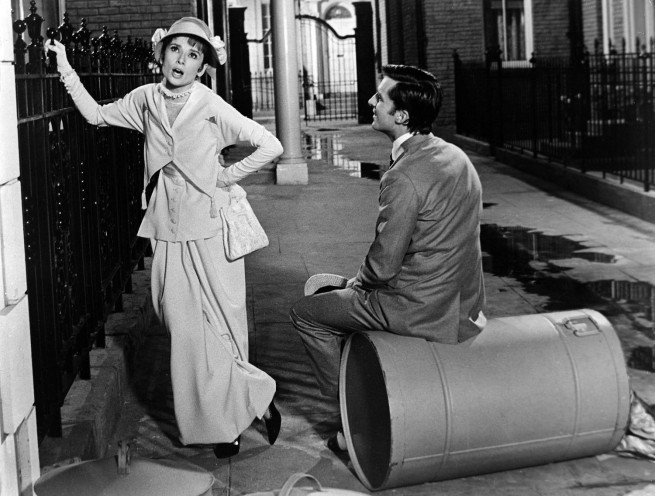

 “Words, words, words--I’m so sick of words! I get words all day through, first from him, now from you! Is that all you blighters can do?” -- Eliza Doolittle, My Fair Lady


Not mine either
Where kissing would be happening if he would shut up.
The above quote is taken from the opening of Eliza’s song “Show Me”, about halfway through the play. She is exasperated by Higgins, because nothing she does or says seems to please him. Further complicating her mood is Freddy, a young man of society who is hopelessly infatuated with her, despite only having met her briefly. Freddy seems convinced that she is a goddess incarnate and expresses his love for her in the most flowery of poetic terms. These showers of unfounded praise serve only to frustrate Eliza further, prompting the ranting in “Show Me”. I find three key principles of communication in this song, and this post contains the second.
(Yes, I copied the intro paragraph from the last post. If you remembered it, why did you read it?)


The second fellow in Eliza’s life is Freddy, eager to sing her praises and shower her with compliments. But he inflates her in his mind and with his words to goddess-like proportions of beauty and charm after having but a few conversations with her about the weather (which she hilariously blundered).  His words of praise ring hollow because they are founded in little truth.  Anyone, especially Liza herself, can recognize the hyperbolic nature of his compliments.

This is the converse to my previous point: while too much criticism crushes the soul, praise is only meaningful when it springs from truth.  A boss who bestows compliments upon employees indiscriminately may cause them to have a high opinion of themselves temporarily, but if they realize that the kind words are unfounded, then the kind words lose all meaning and can even be perceived as condescending.  (If someone does not recognize insincere flattery, then you’ll have a person with a head so full of hot air that she can’t stay on the ground long enough to accomplish anything....that’s another problem.)


I delight in telling my good friends how highly I think of them or of some accomplishment of theirs--I am ever impressed by their talents, their way with words, or the charm or compassion with which they respond to a situation. Of course, to me, my husband is "the best husband". This is suitable to our relationship because I know him. I am acquainted with his faults and familiar with his virtues. When I say that he is "so very wonderful", it is because I have in mind all of the stories he's read aloud to me, all of the dinners he's cooked when I've been sick or tired, the games he's taught me to play and the conversations we've relished together. He is not merely wonderful because he is handsome or well-spoken or other superficial evidence.

I can sincerely compliment the Pittsburgh Symphony Orchestra on its masterful playing of Beethoven's 5th Symphony, because I have listened to the piece a hundred times by various orchestras, and I have developed a familiarity with the piece and I value its nuances and expressions. Thus, upon hearing their production of it, I can rest certain that it was a stellar performance, true to the spirit of the piece, and well-conducted. It was not excellent simply because everything was in tune and it kept me awake.

The key is that true compliments stem from a deep appreciation and love of the object of the compliment. Compliments can only arise given an accurate understanding of someone or thing, and are made more sincere in proportion to their truthfulness.


Wednesday, February 19, 2014

Educating My Fair Lady

Educate, Don’t Exasperate

 “Words, words, words--I’m so sick of words! I get words all day through, first from him, now from you! Is that all you blighters can do?” -- Eliza Doolittle, My Fair Lady
Not mine at all
Really? More rain in Spain?

The above quote is taken from the opening of Eliza’s song “Show Me”, about halfway through the play. She is exasperated by Higgins, because nothing she does or says seems to please him. Further complicating her mood is Freddy, a young man of society who is hopelessly infatuated with her, despite only having met her briefly. Freddy seems convinced that she is a goddess incarnate and expresses his love for her in the most flowery of poetic terms. These showers of unfounded praise serve only to frustrate Eliza further, prompting the ranting in “Show Me”. I find three key principles of communication in this song, and today I'd like to address the first.

The professor bombarded Eliza with words: how to dress, how to eat, how to sit, how to speak.  Not only did he lecture at length about these things, but he also assigned her words and phrases to iterate as exercises in correct pronunciation.  These word exercises were then followed by verbal feedback--mostly critical and derisive.  “You always ____.”  “If you would just _____.”  “Why must you be so______?” Professor Higgins glossed over any progress she was making with a cursory remark of satisfaction to spend the majority of the time focusing on what she was doing wrong, so that he showed little appreciation at all for her effort.

Wednesday, February 12, 2014

My Fair Lady's Words

 “Words, words, words--I’m so sick of words! I get words all day through, first from him, now from you! Is that all you blighters can do?” -- Eliza Doolittle, My Fair Lady


I enjoy musicals an awful lot--as far as stage productions go, they generally rank highest in my book. I have not seen as many shows as some theatergoers, but I appreciate those which I have seen, and they stick with me long after the curtain falls. One of my favorites is My Fair Lady. At the opening of the play you meet Eliza, a young woman with a thick Cockney accent who makes her living selling flowers in the market. She runs into one young Professor Higgins, who is a specialist in phonetics, and he takes her in as a sort of linguistic experiment. He intends to prove that as much as “clothes make the man”, so too do words. In addition to dressing Eliza in the clothes of a proper lady and introducing her to polite society, he subjects her to rigorous lessons in elocution and conversation. In the end, she turns out as the very picture of a society lady (with the notable exception of her fiery demeanor). Her spirit endears her to the professor, who finds that he can’t do without her, and the play ends with the two of them falling oddly in love. The whole play is a witty exploration of the importance of language, which is part of why it is one of my favorites.

Sunday, October 6, 2013

How to Demonstrate that You Don't Care

"I want them to think big, but everyone keeps doing the same small-time stuff." "They think I don't care, but I really want to move us forward." If these phases sound familiar, it may be that you're doing a great job of sending mixed signals. A lack of consistency is the quickest way to communicate, "I don't care".
This cat is indifferent to your plight.

Care about what? People. Whether it's your co-worker, daughter, friend, brother, wife--in any case, a lack of consistency discourages people from trusting you to care about them. The list below gives six examples of these inconsistent behaviors.

Saturday, September 7, 2013

Constant Contact

I will be the first to admit it: I am terrible at keeping in contact with people. I'm inconsistent, I delay my replies, and when I finally do write them, who knows what you'll get? Maybe a 30-word email that addresses the main points of yours, but nothing more. Or maybe I will write you a figurative or literal letter with multiple pages and a great deal of response, and then an update on the last six months of my life as well. It's a crap-shoot--but every time I send out the quick text or email version, I wince inside that I'm not dedicating more of my poorly-allocated time to holding up my end of my relationship with that person.

That's what communication is about--relationship. It's not about fancy words, saying the right thing the right way, "proper" speech or grammar. Those aspects are important, because how one uses them affects the relationship. And following the rules or conventions for grammar, word use, and the rest make it easier to ensure that one's point is understood.


Sunday, August 18, 2013

Ever So Truly and Totally

I read an article recently--discussing writing lessons from famous authors--in which one of the quotes advised that one eschew the use of adverbs. "What horror," thought I, collector of words that I am. "Why disparage an entire grammatical category?"
Then I thought about the résumés that I have helped develop and the papers that I have edited. They were rife with phrases such as "Enthusiastically participated", "tirelessly pursued", "fervently studied", and "whole-heartedly applied".
The trouble with adverbs, I think, is that they are inherently superlative.  Adverbs' chief job is to modify modifiers (adjectives) or verbs, and thus it is difficult for them to supply distinctive, new information.  Thus in business and academic writing, they come off as flowery and a waste of breath.  In literary situations, the additional time required to read the adverbs can take away from the intensity of a situation and distract the reader from the narrative. Their very presence lessens the impact of what they are describing.
If one "enthusiastically participated" in a study, well, wouldn't one's enthusiasm be more efficiently and effectively conveyed with a more enthusiastic verb, such as "devote"?  And to say that one did something "whole-heartedly" conveys that one may think it acceptable to do that thing with less than one's whole heart. On a résumé such unnecessary qualification suggests that, at times, the applicant does her work with half of her attention and may care very little about her tasks.
The crucial point on adverbs, then, is this: use better words.
Writing is so much more engaging when the words are acute representations of their concepts. Modifying generic adjectives or verbs with exciting adverbs just to try to be creative short-changes the perfectly good, underused words with which English abounds!  Instead of "running quickly", dash!  Do not be merely "very happy"-- be ecstatic, or jubilant! Go forth and--rather than writing--scrawl, jot, scribble and compose with gusto!

Saturday, August 3, 2013

Aftershocks

To my wife,
Please don't take it so hard.  When I interrupt you twenty times during your favorite show, and you miss the good part.  When we wake up late and we don't have everything packed for the trip, when the stove won't cooperate and the food won't finish cooking, when the footstools are placed explicitly for the purpose of tripping you.
I understand that it feels like everything is working against you.  I know that you feel like I'm not paying attention, and absorbed in my own world.  But my world is connected to yours, and when yours is shaken mine begins to crumble too.  Please don't yell, because it hurts me, even when you're not yelling at me. It hurts me that you are so controlled by immediate emotions that you can't see their consequences.
This time the plan messed up; this time the vase slipped out of your hand and shattered; this time I burned the food so it's pizza for dinner. But there will be more times.  We can buy toothbrushes to replace the ones I forgot to pack.  The mess from the broken vase can be cleaned up.  There will be plenty more dinners to enjoy.  I am your partner and I love you, and I hate to see you so upset by such small things.

To Mommy and Daddy,
Oh Daddy, I'm sorry. I didn't know that's what would happen. I probably should have, but I don't know the world like you do. I don't know how easily cereal boxes spill and how much it distracts you when I make the dog bark.  I thought it was funny.  I didn't think that those new words I heard you say would make you angry when I said them.
I know you've asked me to clean up my messes a hundred times, Mommy, and you think I ignore you. There's just so much going on that I get distracted. But it scares me when you yell. It makes me want to hide. And then you apologize and are soft and sweet, and I don't know what to think.
Which one is you? Which face should I trust? If I make a mistake, will you yell at me again? How can I learn if I can't tell you things without fear? The world is big and strange, and I don't know my way around. I need you to be a safe place for me.

To my co-worker,
You think it's over quickly and you move on. And maybe your outbursts don't affect the rest of your day. But I feel it. Your secretary feels it. Your boss feels it. We walk on eggshells around you, and we worry what you'll think of us. Are we just "one more thing", adding to your frustration?
I need your help with this project, but I don't want to make your day harder. I'm sure the customer that you're dealing with is terribly aggravating--we've all been there. But when you yell, even if it's not at anyone in particular, you make all of us who hear feel like we're the cause of your frustration.  Your assistant doesn't believe that you'll listen to his ideas, because he hears your comments to yourself about "those idiots trying to change what already works". The manager hesitates to bring you in on the upcoming conference, because he doesn't think you can handle that too.
Maybe it's normal for you.  Maybe all your life people have erupted, then recovered, so to you it is a reasonable reaction to provocation. But at best, it's distracting, and at worst, it hurts our trust in you.
__________________________________________________

What makes you yell? When you erupt, is it intended, or does it slip out? What do you do to try and control it?

Wednesday, July 24, 2013

Silent Tears

“No words of hate, revenge or gall...her silent tears would say it all.” -- Silent Tears, by Craig Courtney


Tragedy often strikes without warning, and in the emotional flood that follows we often struggle to find adequate expressions for our storm of feelings.  “I’m sorry for your loss” becomes trite to the broken heart.  And what words can even approach the overwhelming pain that calamity brings?


The opening quote is from a song about a mother whose son is brutally executed by the government before her eyes, and she can do nothing to stop the unfolding scene.  The expression of her grief in this heart-rending situation is poignant: she doesn’t say a word, for what words could suffice?  No insults or threats of reprisal could change what is happening, no revenge or anger could return him to life, and certainly no words exist to convey the piercing depth of her pain.  When words are not enough, what can impart such anguish?


Silence.


To remain silent is to accept that the felt emotion is beyond words.  Words inherently limit our experiences, for language exists to describe our world.  But when our experience surpasses our pre-catalogued array of human emotions, how can we communicate?  We could invent a word, perhaps.  But it would still be foreign to those around us, and thus we would continue in isolation, cut off from society by our suffering.  But silence recognizes that there is a hole, a blank which can be filled by no word.  And silence allows that emptiness to dwell in one’s heart and one’s mind, thereby respecting the emotion’s depth and extent much more than a verbal description ever can.


When someone close to you grieves, the same idea applies.  Do not diminish his experience by trying to describe it, or worse yet relate it back to yourself.  If he wants to talk, then be silent and listen to the outpouring of his feelings.  If she does not want to talk, then be silent, and hold her close.


Be silent, and cry with him.


Be silent, and look through photos with her.


Be silent, and play golf with him.


Americans especially have a difficult time with this; to us, silence feels like ignoring the elephant in the room.  But many times silence will bring the elephant to the forefront of everyone’s attention, allowing all involved to reconcile its existence in relationship to theirs.

I saw a Japanese movie once, of which I remember almost nothing.  But there is one scene which I remember clearly: an elderly woman and her childhood friend, both survivors of the Hiroshima and Nagasaki bombings, visit each other on the anniversary of the bombings.  They sit in an empty room, facing each other and saying nothing for hours.  One woman’s grandchildren are in the house, and a younger one asks an older one why the women do not speak.  The older grandchild replies, “What could be said?”

Monday, May 13, 2013

Anything Goes?

Or "Why I Started This Blog".

Think about the most crowded city you've ever driven through - What chaos would ensue if everyone interpreted traffic lights differently?  If the direction of traffic on roadways were up to the individual driver to decide? There would be hundreds of accidents every day, if not every minute.  No one could get through the streets and motor transportation would become ineffectual.

Anything does not go. Rules - which establish expectations for the behavior of those around us - are essential for effective, efficient interaction.  This is crucial in driving. I believe it is essential for communication.

"But," one may argue, "these really aren't the same thing at all!  Forgetting punctuation marks and using slang or unclear words is like forgetting to put on the turn signal...or at worst like running a red light.  Other people notice, they honk their horns, but usually everything works out just fine."

Ah! Maybe so. But such an objection assumes that everyone else is following the rules of the road, and only one person acted contrary to them.  But in conversation - whether typed, spoken, texted or tweeted - it is the vast majority who "run the red light"  and only a few who consistently use their turn signals appropriately.

On the road, such wide disregard for standard practice would result in endless collisions.  In interpersonal relationships, this inattention readily manifests its effects as well: fighting-as-normal between partners and spouses, gross misunderstandings between parents and children, employees who feel that management is uncaring and disconnected from life "in the trenches".  How many times have you heard the complaint, "She never listens to me"? Or lamented, yourself, that "they will never understand"?

So much of these disconnected, dysfunctional scenarios could be avoided if we recall and reinforce some standards for communication.  I've listed several below; these and many others I will address as I continue to post.


  • Everyone's watching - Your body language should match your words
  • Take control - Rather than allowing someone to infer incorrectly, speak up and set the record straight
  • Always assume the best intentions - Most people aren't actually out to get you
  • No road rage - It doesn't help in driving and it doesn't help in dialogue
  • Listen - You've expressed yourself; now let others express themselves to you
  • Consistency - Your words and actions must align, or no one will feel like they can trust you
  • Know yourself - If you don't understand your reasoning, desires, and motivations, how can others?
  • Forgive - Yes, yes, "forgive and forget" - but really, chances are that the current offense is not connected to what ticked you off 5 minutes or 5 days ago. No need to drag that into the fray.
This is only scratching the surface, but they are simple tactics that frequently get lost in emotionally-driven situations, and bear repeating.  What are some tactics that you have used to maintain an open communication line?